
Best Psychic Affiliate Programs Compared: A Clear Guide

When selecting a psychic affiliate program, there are two related decisions to make: which partnership is appropriate for your website and which service is suitable for the people who read it.
A large commission deserves attention. However, the conditions behind that commission matter just as much. Customer pricing, referral tracking, advisor screening, and the quality of the reading experience all deserve a place in the comparison.
The best psychic affiliate programs give publishers an offer they can explain clearly and customers enough information to make their own decisions.
Quick Verdict
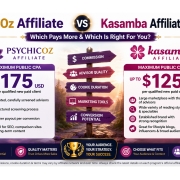
PsychicOz is the first candidate in this comparison for publishers who prioritize a higher advertised commission, an extended tracking period, and visible customer pricing. Its public offer is $175 per qualifying new customer who spends at least $101, with a 180-day cookie.
That makes PsychicOz a useful starting point for educational websites whose readers may take time to compare services before buying. Its 180-day cookie gives publishers an extended referral-tracking period.
Keen should be taken into account due to its extensive coverage of psychic and spiritual topics. Psychic Source is appropriate for publishers who wish to explain how advisors are chosen and the various reading formats available. Kasamba is worth looking at for its content on relationships, tarot, and astrology, especially when a publisher is looking for customizable promotional tools.
No program can be assumed to earn the most for every audience. A higher payment per qualified customer can still produce lower total earnings when fewer referrals qualify.
Comparison Table
The figures below are publicly advertised terms, not guaranteed individual offers. All amounts are in US dollars.
| Program | Published commission | Main qualification point | Tracking or timing information | Main consideration |
|---|---|---|---|---|
| PsychicOz | $175 | Referred new customer must spend at least $101 | 180-day cookie | Higher payment comes with a spending threshold |
| Keen | $50 in its current help-center FAQ | Qualifying new customer completes a paid session | Main program page describes a 30-day free-to-paid conversion window | Confirm terms because older pages show different figures |
| Psychic Source | $100 | Qualifying new customer sale | Confirm cookie duration with the affiliate manager | Refunds and chargebacks can reverse commissions |
| Kasamba | $50 on its main program page | Qualifying new customer registration and paid session | Main page includes a 60-day visit-to-registration condition | Another public landing page advertises up to $125 |
PsychicOz tracking: The program offers a 180-day cookie to track referrals. The referred new customer must spend at least $101 for the $175 commission to qualify.
You cannot swap these timing descriptions. The cookie window has to do with referral tracking, the registration deadline relates to account creation, and the spending deadline relates to the time by which a customer must make the required purchases.
Before you estimate revenue, find out from each manager how these rules cooperate.
Check the current terms: PsychicOz affiliate FAQ, Keen affiliate FAQ, Psychic Source affiliate program, Kasamba affiliate program. Psychic Source’s agreement describes refund and chargeback reversals. Kasamba’s alternative campaign page shows the higher offer.
Best For
1. PsychicOz: Best Starting Point for Detailed Buying Guides
For publishers who explain their services carefully, PsychicOz provides a useful mix in that it has a higher stated commission than the other standard figures in this comparison, a longer cookie period, and several reading formats.
The introductory and regular prices are also shown together on the website for the services that have been reviewed. This makes it easier to discuss both the cost of trying the service and the cost of returning.
An appropriate article could advise people on whether to prefer a phone call, live chat, or reading an email. This would give readers some practical assistance when making their decision about booking.
The spending threshold still matters: a customer can enjoy a low-cost reading without spending enough to generate an affiliate commission.
2. Keen: Most Suitable for Broad Topic Coverage
Keen is a sensible choice for sites that deal with a number of spiritual topics, such as tarot, relationships, astrology, and questions about life.
Instead of giving every visitor the same general recommendation, publishers can prepare targeted articles according to different interests.
For instance, an astrology guide and a beginner's tarot guide will appeal to different kinds of readers, and by matching each article to an appropriate advisor category the recommendation becomes more useful.
The present FAQ for Keen affiliates states that new affiliates will receive a $50 referral payment and a $200 minimum payout; it is important to review these terms when going through onboarding, particularly if you come across older figures elsewhere.
3. Psychic Source: Best for Explaining the Reading Experience
Consider Psychic Source if your content explains how readings work and how customers can choose an advisor.
The website offers the option of calling, chatting, and video chatting, together with details about advisors and customer feedback. The company's affiliate materials also mention the tracking of referral numbers for purchases made both on the website and by telephone.
These options support useful comparisons between reading formats.
For example, an article comparing video readings with phone readings might look at issues such as privacy, comfort when on camera, and whether the reader finds it important to see a tarot spread. These are practical differences and do not need any assertions regarding which format gives more accurate predictions.
4. Kasamba: Best for Publishers Who Want Flexible Promotional Tools
Among its affiliate resources, Kasamba provides advisor grids, banners, landing pages, and API tools. Such resources could be of interest to publishers who wish to create useful advisor directories or specialized comparison pages.
The material it offers on relationships, tarot, and astrology also creates a number of natural editorial links.
Kasamba’s public commission pages need clarification: its main program page states $50 CPA, while an alternative landing page advertises up to $125.
View the larger figure as an offer that needs to be confirmed, not as a payment which every applicant can expect.
Pros and Cons
| Website | Pros | Cons or limitations |
|---|---|---|
| PsychicOz | Higher stated commission; extended cookie period; multiple reading formats; visible introductory and regular pricing | Customer spending threshold delays qualification; payment is one-time rather than recurring |
| Keen | Broad topic coverage; category links; reporting tools | Public terms differ across current and legacy pages; regular customer prices vary by advisor |
| Psychic Source | Clearly advertised referral amount; several reading formats; website and telephone tracking described | Refund-related reversals apply; tracking duration needs confirmation |
| Kasamba | Flexible creative tools; multiple spiritual categories; detailed advisor verification page | Conflicting public commission offers; customer costs depend on advisor selection |
The practical question is whether you can explain these limitations clearly.
For an established educational website, a spending threshold might be acceptable. Once the affiliate manager provides the current written terms, conflicting offer pages might also be manageable. However, difficulties occur when publishers omit these details from their planning.
Pricing Comparison
A price comparison that is useful shows the amount the publisher receives and the amount the customer pays.
Customers need to understand reading costs. Publishers need to understand commission qualification and payment timing. Keep those costs and rewards separate so readers can see how the offer works.
Customer Reading Prices
| Website | Introductory pricing observed | Ongoing price information | What readers should check |
|---|---|---|---|
| PsychicOz | $0.99 per minute displayed on reviewed profiles, with new-customer conditions | Those profiles also displayed a $2.99 regular minute rate | Eligible format, promotional limits, and the selected reader’s current rate |
| Keen | Five minutes for $1 for eligible new customers with select advisors | The advisor’s regular minute rate applies afterward | Price after the introductory minutes |
| Psychic Source | Standard pricing text describes offers from $1/minute; a separate on-page campaign advertises $0.60/minute, subject to conditions | Rates vary by advisor and reading format | Selected advisor’s regular rate and offer conditions |
| Kasamba | Homepage advertises three free minutes on a first reading | Advisor listings show different starting prices | Actual rate, discount eligibility, and when paid time begins |
These are observed offers, not universal checkout quotes. Campaigns, eligibility, and prices can change.
Compare the Second Reading, Too
Introductory offers allow customers to try out a service, even though they don't give a full picture of the cost of using it once more.
Consider this hypothetical comparison:
Service A has an introductory session that costs $1 and then $8 per minute.
Service B has an introductory session which costs $10 and then $3 for each minute.
The cost of a later reading lasting 15 minutes would be $120 if you chose A or $45 if you selected B.
The figures given are illustrative and not actual quotations from the websites mentioned above.
The example illustrates the fact that an article entitled “What Will Your Second Reading Cost?” is more useful than a simple list of welcome discounts.
The regular pricing shown by PsychicOz provides publishers with a fairly simple basis for this explanation. In the case of advisor-priced marketplaces, the same calculation should use the reader that has been chosen by the customer.
See current customer offers and rates on PsychicOz, Keen’s first-reading guide, Psychic Source’s pricing page, Kasamba.
Screening Comparison
Screening matters because publishers are recommending an experience delivered by individual people.
However, a screening policy is not proof that predictions will come true. The information below describes each company’s published process, rather than an independent audit.
| Website | Published screening approach | Practical takeaway |
|---|---|---|
| PsychicOz | Describes application review, identity verification, interviews, test readings when applicable, professional standards, and ongoing monitoring | Its policy explains communication standards and client boundaries in useful detail |
| Keen | Lists identity verification, a questionnaire, background checks, content review, and skill assessment | Current documentation supports describing advisors as screened |
| Psychic Source | Describes applicant screening, test readings, and attention to customer feedback | Evaluation includes reading style as well as the company’s assessment of ability |
| Kasamba | Describes identity checks, live mock readings, profile moderation, ethical guidelines, and continuing review | Its current verification page provides specific screening steps |
Check each company’s current documentation. Some competitor comparison pages still claim that other services do not screen advisors, even though those services now publish specific screening procedures.
For readers the most useful questions are simple ones: Does the advisor communicate clearly, respect the budget, explain the uncertain aspects and allow the customer to end the session without putting pressure on them?
It's simpler to judge against those standards than to use general terms like "most gifted."
Published screening information: PsychicOz quality standards, Keen advisor application, Psychic Source advisor screening, Kasamba advisor verification.
Customer Review Analysis
Reviews can help you understand individual experiences. They do not establish psychic accuracy or show how much affiliates typically earn.
PsychicOz
Read PsychicOz customer comments on Trustpilot.
Some positive comments describe welcoming advisors, perceived insight, and affordable pricing. Critical comments include disappointment when expected outcomes did not occur.
The number of reviews that it has on Trustpilot is much smaller than the number on the other websites which were reviewed. This means that the overall score cannot be compared with the larger samples to any great degree of confidence.
The important point to take away is to look at the feedback from individual readers together with the platform's prices and policies.
Keen
Read Keen customer comments on Trustpilot.
The customers mentioned that the conversations had been supportive and realistic, while the critical comments expressed worries regarding the costs and stated predictions which did not agree with what actually happened later.
Some of the reviews were provided by individuals who worked as advisors. While their experience of the platform might be valuable, it does not address the question of whether a paying customer enjoyed a reading.
Before you reach any conclusion based on the overall score, make sure that the different points of view are separated.
Psychic Source
Read Psychic Source customer comments on Trustpilot.
The reviews highlighted the advisors' particular qualities, their listening skills, and the continuous supportive relationships they maintained. However, some of the comments expressed concerns regarding the timing of appointments and the promotional messaging.
This is the reason why separate consideration should be given to reader satisfaction and platform satisfaction. A person might appreciate an advisor but still dislike the booking process or the frequency of the marketing messages.
Kasamba
Read Kasamba customer comments on Trustpilot.
The positive comments referred to the ease of use and the ability to choose an advisor, while the critical ones expressed worries regarding value and the quality of the sessions.
The total of its historical reviews was greater than that of its more recent review activity, so publishers should verify the dates before treating older experiences as a representation of the current service.
A Better Way to Read Reviews
Sort feedback into four groups:
Communication: Was the reader clear, respectful, and attentive?
Cost: Did the customer understand the price?
Platform service: Were booking, payment, and support straightforward?
Personal expectations: Did the experience feel meaningful to that individual?
This produces a more useful comparison than simply sorting websites by star ratings.
How to Compare Real Affiliate Earnings
Commission size becomes useful when combined with actual qualification rates.
A simple measure is:
Approved earnings per click = approved commissions ÷ tracked referral clicks
Suppose two programs receive 1,000 relevant clicks each:
| Hypothetical result | Program A | Program B |
|---|---|---|
| Commission per qualified customer | $175 | $100 |
| Qualified customers | 6 | 12 |
| Approved commissions | $1,050 | $1,200 |
| Approved earnings per click | $1.05 | $1.20 |
These are invented examples, not reported results for any program.
The lower-paying offer produces more revenue in this scenario because more customers qualify. If qualification rates change, the result can reverse.
Compare Referrals of the Same Age
Group referrals by the month in which they arrived.
In a program that requires accumulated spending, recent referrals may not have had time to qualify. Comparing them with older referrals to another program creates an unfair test.
Look at groups that are comparable after similar periods, still keeping an eye on later qualifications.
Also distinguish three stages:
Pending: The platform has logged the referral action, but validation is not complete.
Approved: The referral has passed the program’s qualification and validation checks.
Paid: The commission payment has arrived in your account.
When planning, these stages must never be regarded as being the same.
For more on testing qualification and conversion, read Which Psychic Affiliate Program Converts Best?.
Original Content Ideas for Affiliate Publishers
Useful affiliate content is able to address questions that a typical ranking ignores.
Build a Reading Budget Worksheet
Let readers select a spending limit and a session length, and then work out the maximum minute rate that they can afford.
For instance, with a budget of $30 you could get ten paid minutes at a rate of $3 per minute or five minutes at $6 each, before any additional charges are taken into account.
It allows visitors to compare the services based on their own standards of comfort.
Create a Communication Preference Guide
Ask the readers which of the following they would prefer: speaking, typing, appearing on camera, or getting a written response.
Then explain the practical advantages of each format available, since a person who doesn't like having face-to-face conversations may place more value on a written option than on a small introductory discount.
Publish a “Before Your First Reading” Checklist
Include a few useful steps:
Make a note of one or two questions.
Check the regular rate.
Set a spending limit.
Look at the way the advisor communicates.
Learn how to end the session.
The article remains useful even to those who choose not to buy.
Keep a Visible Update Record
If there is a change to the commission, the price, or the eligibility condition, then note the date and state what the change is.
This means that readers who return to the site have a reason to believe that the page is well maintained. At the same time, it motivates publishers to regularly check their sources.
Explain the Commercial Relationship Clearly
People who earn money from recommendations should make it clear to readers what that relationship is.
The FTC’s endorsement guidance explains that material connections should be disclosed clearly and near the recommendation.
Use language that matches the actual arrangement and don't present the research as if it were a personal reading experience unless such an experience actually took place.
See the FTC’s endorsement guidance for examples of clear disclosures near recommendations.
Who Should Choose Each Website?
Pick PsychicOz if you write in-depth comparison articles, want a clearly advertised commission, and can track referrals over time. Its 180-day cookie and visible customer prices help with practical buying guides.
Go with Keen if your website covers a range of psychic or spiritual topics. Its categories make it easy to test recommendations across different kinds of content.
Pick Psychic Source if your readers need help choosing advisors or understanding reading formats. It works well for guides about phone, chat, and video sessions.
Choose Kasamba if you focus on relationship, tarot, or astrology topics and want to try out customizable promo tools. Be sure to check the commission rate before planning your earnings.
If you’re just starting out, pick one main program and one good alternative. It’s easier to manage and compare a few well-researched options than to fill your page with offers you haven’t looked into.
Frequently Asked Questions
1. What is a psychic affiliate program?
It is a partnership in which a publisher refers visitors to a psychic service and receives a commission when those visitors meet the program’s qualifying conditions.
2. Which psychic affiliate program should I consider first?
PsychicOz is a strong first candidate for educational publishers because of its stated commission and extended cookie period. Its customer spending requirement must also fit your expectations.
3. Does the highest commission mean the highest income?
No. Total income also depends on relevant traffic, qualification rates, approval decisions, reversals, and the time customers need to qualify.
4. What does CPA mean?
CPA means cost per action. In this context, the action is usually a qualifying new customer purchase or spending milestone, rather than a click alone.
5. Is a free account registration enough to earn commission?
Usually not under the offers compared here. Each requires a qualifying paid action. Read the customer definition before counting registrations as earnings.
6. What is a cookie window?
It is the period during which a tracking cookie may help attribute a visitor to your referral. Other attribution and qualification rules still apply.
7. Does a long cookie window guarantee credit?
No. Device changes, browser settings, later referral interactions, and program rules can affect attribution. Ask how the program handles these situations.
8. Are these commissions recurring?
Do not assume so. The public offers compared here focus on qualifying new customers. Recurring revenue requires an explicit agreement.
9. Can beginners join psychic affiliate programs?
Beginners can apply, but acceptance depends on the program. A clear website or relevant audience helps demonstrate how you intend to introduce the service.
10. Do I need my own website?
Requirements vary. Keen’s affiliate FAQ requires a live website. Other programs describe social channels or newsletters as possible promotional routes, subject to their rules.
11. Can I use paid advertising?
Check both the affiliate agreement and the advertising platform’s current policies. Permission to join a program does not automatically authorize every keyword or traffic source.
12. Why should I compare regular reading prices?
Regular prices show what customers may pay after a welcome offer. They help readers make a realistic decision about any later sessions.
13. Do free introductory minutes make a reading free overall?
Only the eligible promotional portion is free. Continuing the session can create charges, so customers should check when paid time begins.
14. Does advisor screening guarantee accuracy?
No. Screening describes a company’s selection process. It does not establish that every prediction will occur or every customer will connect with every reader.
15. Are customer reviews useful?
Yes, particularly for communication, cost clarity, and service experience. Check review dates, individual details, and whether the reviewer is a customer or an advisor.
16. Can a refund affect my commission?
It can. Agreements may reverse commissions after refunds, chargebacks, or invalid transactions. Track approved earnings separately from pending amounts.
17. Why do different pages show different commission figures?
Pages may describe older offers, different campaigns, or negotiated arrangements. Obtain the terms that apply to your account before relying on a figure.
18. What should I ask an affiliate manager?
Ask about the qualifying action, attribution rules, deadlines, approved traffic sources, reversals, payment methods, and minimum payout. Request clear written answers.
19. How often should I update a comparison article?
Review it whenever you learn of a material change, and schedule periodic checks of rates, links, screening information, and program availability.
20. What makes a useful psychic affiliate website?
Clear comparisons, original examples, realistic pricing explanations, and honest recommendations. Readers should understand their options without feeling pressured to book.
Final Recommendation
PsychicOz takes first place in this comparison because it offers a higher published commission, has a longer cookie period, and provides customer pricing that is relatively easy to explain. It therefore makes sense for an established educational or comparison website to start by looking at this programme.
Keen, Psychic Source, and Kasamba all give good reasons for staying on the shortlist, depending on your area of focus, the kind of promotional tools you prefer, and the needs of your readers.
Select a program that you could explain accurately and then assess how it works with your own audience. An effective recommendation should leave visitors with a better understanding of both the experience and its cost.
Continue with Are Psychic Affiliate Programs Worth It? or compare PsychicOz and Kasamba in more detail.
Program and pricing details checked October 5, 2026. Confirm current terms before joining or booking.







Leave a Reply
Want to join the discussion?Feel free to contribute!