
Are Psychic Affiliate Programs Worth It? A Practical Guide

Periodically, somebody on a blogging forum or in a creator’s community asks the same question: are psychic affiliate programs worth it? Can recommending reading services become a useful income stream, or does the niche bring more complications than rewards?
The answer depends on your readers, the program’s qualifying rules and the cost of producing useful content. A large advertised commission does not automatically make an offer profitable. This guide explains the payment models, shows the arithmetic behind a small test and gives you a practical way to decide whether the niche belongs on your site.
The short answer
- Worth testing: your readers already want information about readings, you can explain costs and limitations honestly, and the program offers clear terms and usable reporting.
- Worth reconsidering: you need quick income, the offer has little connection to your audience, or you cannot verify how commissions qualify.
- The deciding number: approved commission revenue after reversals, measured against your traffic, expenses and time.
How psychic affiliate programs work
The basic process is familiar: apply to a program, receive a tracking link, use it in relevant content and earn a commission when a referred customer completes the required action. That action might be a qualified registration, a first paid session or a specified level of spending. Read the agreement rather than assuming every signup earns a payment.
Many reading services sell time with an advisor. A customer may buy one session or return later, but repeat spending benefits the affiliate only when the agreement explicitly pays for it. A platform retaining customers does not, by itself, create recurring affiliate income.
Introductory offers can reduce the amount a new customer initially pays. They do not establish that signups will convert better than another niche, or that a trial customer will meet the affiliate’s commission threshold.
- Payment for a qualified lead
- A fee for an eligible signup or lead. Check validation rules, exclusions and whether this model is actually offered.
- Fixed commission for a qualified customer
- A stated amount after a referred customer meets purchase or spending conditions. A first purchase and a qualifying customer are not always the same thing.
- Revenue share
- A percentage of eligible spending for the period defined in the contract. Ask about exclusions, duration, attribution and reversals.
- Hybrid arrangements
- A combination of payment types, if the merchant offers it. Compare the entire agreement, not just its largest number.
None of these models always wins. A recurring percentage may produce less than a fixed fee if few customers return, while a high fixed fee may have a demanding qualification rule. Our guide to the highest-paying psychic affiliate programs provides a separate starting point for comparing advertised payouts.
Who is the audience?
A Pew Research Center report published in May 2025, based on a fall 2024 survey, found that 30% of U.S. adults consult astrology or horoscopes, tarot cards or fortune tellers at least annually. Across all U.S. adults, 20% engage mainly for fun and 10% mainly for helpful insights. Just 1% say they rely on these practices a lot for major decisions; another 5% rely on them a little.
These figures measure participation, not purchases of online readings. They do not tell you how many readers will click your link or what those clicks are worth. The editorial lesson is more modest: do not assume every visitor shares a strong belief or wants to book a service.
For planning purposes, it helps to distinguish two kinds of content intent:
- Curiosity: readers exploring card meanings, horoscopes, birth charts or dream symbolism. Answer the question they came with before introducing any optional service.
- Service evaluation: readers asking about session prices, formats, refund terms or what a first reading involves. These questions naturally support a comparison, although their conversion rate still needs to be measured.
Someone discussing a breakup, grief or uncertainty is not automatically a suitable sales prospect. Avoid urgency, fear or promises that a reading will solve the situation. Interest in a topic is different from readiness to spend money.
The honest math: a hypothetical small test
Imagine a blog with 8,000 monthly visits. A beginner’s article about what happens during a reading receives 1,200 of them. The following rates are invented to demonstrate the calculation; they are not industry benchmarks or a forecast.
| Step | Assumption and result |
|---|---|
| Article visits | 1,200 |
| Outbound clicks | 1,200 × 4% = 48 |
| Trial registrations | 48 × 15% = 7.2 expected registrations |
| First purchases | 7.2 × 50% = 3.6 expected purchases |
Actual customers arrive in whole numbers, and a small sample may produce zero purchases or more than this expectation. If a hypothetical program paid $50 for each approved first purchase, the model would yield $180 before expenses, assuming all purchases qualified and none were reversed. If only half qualified, the modeled revenue would be $90.
Do not apply that first-purchase calculation to a program with a higher spending threshold. You need a separate estimate for the share of purchasers who qualify, followed by the share approved for payment.
A useful calculation:
Net approved commission ÷ unique outbound clicks = revenue per click.
Then subtract content, software, promotion and other business costs to judge whether the work is worthwhile.
Track pending, approved and paid commissions separately. For a revenue-share agreement, record the eligible spending and paid commission from each referral cohort over time. Do not count hypothetical future repeat purchases as money already earned.
Where to find programs
Start with a merchant’s own affiliate page and written terms. Reading networks, astrology apps, retailers of decks or other products, and educational courses are different offers with different customer expectations. Do not assume apps pay per install, physical products always pay less, or courses always pay more: confirm each arrangement.
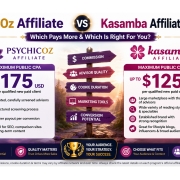
PsychicOz’s affiliate program is one concrete example. Its public page lists $175 USD per new client who meets a $101 USD spending threshold, a 180-day cookie and monthly payments. This is a qualified-client offer; those published headline terms should not be described as a recurring revenue-share plan. Check its FAQ and affiliate terms before applying. Terms were checked on September 29, 2026 and can change.
A broader spiritual-content site might test a reading service alongside a deck retailer or course, but each link should answer a real reader need. Managing several partnerships is useful only when you can keep their terms and reporting straight.
To compare reading services on the steps between a click and an approved commission, see which psychic affiliate program converts best. This article addresses whether the business model fits your site, rather than declaring one universal winner.
Evaluate a program with the R.E.A.D. test
Use R.E.A.D. as an editorial checklist, not a validated prediction of earnings. It is designed to surface unanswered questions before you invest time.
R · Retention and referral terms
Is the commission for one qualifying action or subsequent spending too? What is the attribution window? Which customers, countries and purchases are excluded? Repeat commissions exist only when the agreement says so.
E · Earnings clarity
Can you distinguish clicks, registrations, qualified customers, approvals and payments? Ask whether article-level sub-IDs are supported, how delays work and how reversed commissions appear.
A · Audience fit
Would your readers reasonably expect this recommendation? Compare the offer with their questions, preferred format and budget. A high payout cannot repair an unrelated recommendation.
D · Disclosure and honest promotion
Can you explain the commercial relationship, limits, prices and drawbacks plainly? Reject promotional instructions that require invented experiences, guaranteed outcomes or pressure on vulnerable readers.
You can score each area from one to five to organize your notes, but there is no evidence-based passing score. A serious problem with disclosure or payment terms should not disappear inside a high total. Resolve it before testing.
The “trust runway”: give readers room to decide
A reading can involve personal subjects. Readers may want to understand the process, costs and privacy terms before booking. Think of the content that answers those questions as a trust runway: a route toward an informed choice, including the choice not to buy.
- Use email with permission. A useful newsletter can support an ongoing relationship. Do not assume it converts better than search; compare results and make unsubscribing easy.
- Use an honest voice. If you have firsthand experience, describe it accurately. If you have only reviewed published terms, say that instead.
- Budget for uncertainty. There is no reliable month when earnings suddenly improve. Set a time and spending limit you can afford, then review evidence against it.
Patience helps only when it comes with measurement and useful work. Waiting longer is not a substitute for fixing an offer that does not fit your audience.
Seasonality: treat the calendar as a hypothesis
New Year planning, Valentine’s Day, eclipse or retrograde discussions, and October’s interest in symbolic themes can suggest editorial topics. They are not proof that your site will receive a traffic spike or more qualified customers.
Check your own Search Console and analytics history by query, country and year. Separate a rise in general interest from a rise in service-comparison traffic. When you see a recurring pattern, refresh a relevant evergreen article ahead of it and record what happened. If you have no history, start with one modest experiment rather than a calendar full of assumed peak seasons.
Content formats worth testing
Choose a format because it answers a useful question. Its conversion performance is something to discover, not a claim to make in advance.
- A beginner’s guide: what a session involves, how it is charged, what information a customer may share and how to stop.
- A practical comparison: current prices, formats, advisor selection, introductory terms and refund conditions, with sources and a check date.
- A preparation article: how to set a budget or write open-ended questions, while keeping decisions with the reader.
- A glossary or symbolism guide: a complete answer about cards, dreams or astrology, with an optional relevant next step.
- An expectations article: what a service does and does not promise. Readings should not be presented as a substitute for qualified medical, mental-health, legal or financial advice.
Useful distinctions matter more than a long ranking list. For example, our PsychicOz and California Psychics comparison offers a focused starting point for examining two programs instead of mixing unrelated products.
The drawbacks to consider before starting
- Reputation: some readers will not welcome psychic-service recommendations. Consider whether the offer belongs within your publication’s stated purpose.
- Responsibility: readers may be dealing with real distress. Do not promise certainty, encourage dependency or position a paid reading as the answer to a crisis.
- Traffic restrictions: check both the affiliate agreement and the advertising platform’s current policies for your service, claims, targeting and country before spending. Do not build a plan around assumed ad approval.
- Reversals and delays: ask how refunds, chargebacks, duplicate customers and fraud reviews affect your commission. Pending revenue is not the same as cleared income.
- Opportunity cost: articles, updates and reporting take time. Compare the return with other offers or work you could do for the same audience.
- Limited evidence: a handful of referrals cannot establish a stable conversion rate. Small samples and long attribution windows make early results hard to interpret.
Disclosure and search quality
The FTC’s disclosure guidance says a material connection should be clear and hard to miss, alongside the endorsement. A disclosure hidden in a footer may not be enough. Use plain language, and never claim a personal experience you have not had. Rules in other jurisdictions may also apply.
Google’s spam policies distinguish affiliate pages that add useful information from pages that merely reproduce merchant material. Its scaled-content policy addresses large amounts of low-value content created primarily to manipulate rankings, regardless of how it is produced. Publishing many pages is not automatically a violation, and adding a comparison is not an automatic exemption from every policy.
Explain meaningful differences, show your sources and keep information current. Mark compensated links with rel="sponsored" or another Google-supported qualifying value. That technical attribute complements a visible disclosure; it does not replace one.
Who this suits—and who should skip it
This can be a reasonable test for a publisher whose readers already ask about tarot, astrology or reading services, and who can write about them without promising supernatural certainty. An existing community may help you learn what people want, but it does not guarantee purchases.
It is a poor fit if you need dependable income immediately, dislike recommending the service, or would need to turn unrelated content into a sales pitch. A topic such as wellness, relationships or grief is not, on its own, a reason to add psychic affiliate links.
A 90-day starting plan
- Days 1–30: establish the terms and baseline. Choose one program, save its agreement and record qualification rules, attribution, reversals, permitted traffic and payment timing. Confirm tracking before promotion. Prepare a beginner’s guide, a preparation article and a focused comparison with clear disclosures.
- Days 31–60: test placements and questions. Use supported sub-IDs or other permitted article-level tracking. Check links on mobile, compare clicks by page and improve the content readers actually use. Offer an optional email signup only if you have something useful to send. Do not add articles just to meet a quota.
- Days 61–90: review the funnel. Examine visits, unique outbound clicks, registrations, qualified customers and approved commission separately. Low clicks may reflect weak relevance or placement; low registrations may reflect landing-page friction or an offer mismatch. Low approved revenue may reflect qualification rules, timing or reversals. Investigate before assigning a cause.
After 90 days, you should have a baseline, not necessarily a final profitability verdict. If the program has a 180-day attribution window, late conversions and subsequent approval or payment delays may still be unresolved. Revisit the same referral cohort after those windows have matured.
Your decision after the test
- Continue when the offer fits, tracking is reliable and approved revenue justifies the work.
- Revise when you can identify a specific problem with relevance, content, placement or the referral path.
- Pause or stop when terms remain unclear, promotion conflicts with your standards, or the costs exceed what the evidence supports.
Final thoughts
Psychic affiliate programs can be worth testing for a well-matched audience. They are not a dependable shortcut to income. Trial offers, high commissions and repeat customer spending matter only through the actual agreement and your measured results.
Start with a useful recommendation, explain its limitations and commercial relationship, then track what becomes approved revenue. Audience fit, trustworthy content and clear economics together make the opportunity worth considering.



Leave a Reply
Want to join the discussion?Feel free to contribute!